Join Our Annual Maintenance Program!

Ever catch a damp, earthy smell when you walk down the hallway? Or notice your floors feel a little softer than they used to? If you live in Crisfield, MD, or nearby Princess Anne, MD, those small clues deserve a closer look.
Crisfield sits low and close to the water, with Tangier Sound to the west and marshland all around. Groundwater doesn’t have far to rise, and summer air off the bay holds a lot of moisture. Both of those work against the space under your house. The signs of crawl space water damage usually show up well before you’re dealing with rotted joists, though. You just have to know where to look.
Here’s what to watch for, what usually causes each sign, and when to hire a waterproofing company instead of waiting it out.
Crawl spaces can hold exposed wiring, sharp fasteners, pests, and mold. If you go in, wear gloves, long sleeves, and an N95 mask, and let someone know you’re down there. Never step into standing water if you see electrical lines or equipment nearby. You can often learn plenty just by shining a flashlight in from the access door.
A musty smell in crawl spaces and, eventually, upstairs usually means moisture has lingered long enough for microbial growth to start. Air from below doesn’t stay below, especially in cooler months. Warm air rises and escapes through the top of the house, pulling crawl space air up to replace it. Building scientists call this the stack effect, and it’s why a smell under the floor can end up in your living room.
Candles and plug-ins cover the odor without touching the cause. If the smell gets stronger after rain or during humid stretches, moisture is almost certainly the driver.
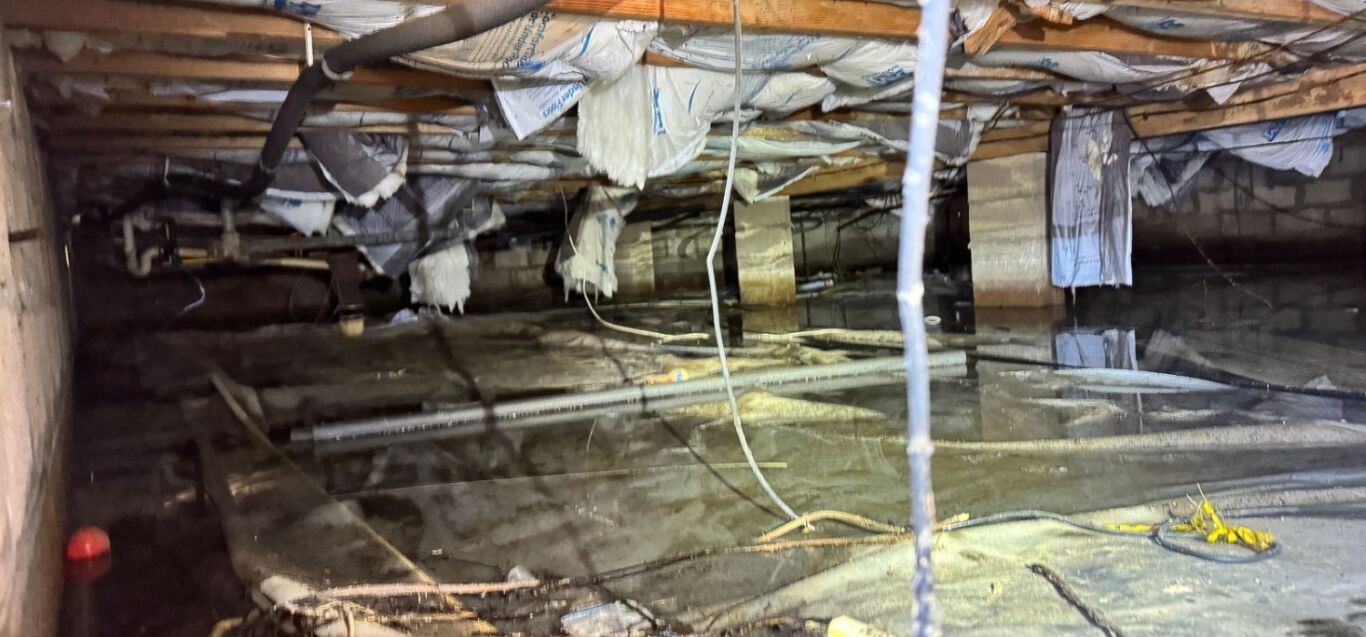
Puddles, muddy soil, and waterline stains on the foundation walls are all clear red flags. In low-lying areas, water often appears after heavy rain or a seasonal rise in groundwater and then recedes. Checking a day or two after a big storm gives you the most honest picture.
Also look for white, chalky deposits on block or concrete walls. That’s efflorescence, the mineral salts that water leaves behind as it passes through masonry and evaporates. It’s harmless on its own, but it shows water is moving through the wall.
Where the water sits matters, too. Water along the walls usually points to runoff or soil saturation outside. Water coming up through the middle of the floor points more toward groundwater, which typically calls for drainage and a sump pump rather than a simple fix outside.
Fiberglass batts between floor joists should sit snugly against the subfloor. Once they absorb moisture, they get heavy, droop, and eventually fall. Wet fiberglass loses much of its insulating value, and it can hold dampness right against the wood. Falling insulation is also a hint that the wood above it deserves a closer look.
Spongy or dipping floors can indicate damaged joists, subflooring, or sill plates. Wood that stays damp for long stretches invites rot and wood-destroying insects. Sagging can also come from undersized framing or supports that have settled, so it’s worth having someone look underneath before you assume the cause. That’s where joist repair, support piers, or a mid-span beam from our crew comes in, along with a structural engineer when the situation calls for one.
Watch for dark spots, fuzzy patches, or white powdery growth on joists, subfloor, or insulation. According to the Environmental Protection Agency (EPA), mold can start growing on damp materials within 24–48 hours. Breathing in mold spores can mean sneezing and itchy eyes for some people. For anyone with allergies, asthma, or a weakened immune system, it can be a lot worse.
Spraying bleach and walking away rarely solves anything. The EPA generally doesn’t recommend bleach as a routine mold treatment, and growth comes back as long as the moisture does. A better approach pairs antimicrobial treatment, part of our microbial growth remediation, with addressing the cause of the wood’s dampness. If you’re getting ready to sell, it helps to deal with this before a buyer’s inspector finds it.
Sticky indoor air, sweaty windows, and water droplets on ductwork and pipes under the house all suggest excess humidity. The EPA recommends keeping indoor relative humidity below 60%, ideally between 30% and 50%. A digital hygrometer from a hardware store lets you track it. Try setting one just inside the crawl space door for a week in July or August, when readings typically run highest.
A lot of people open their crawl space vents in summer to air things out. On the Eastern Shore, that warm, humid air can hit cooler surfaces under the house and condense, leaving the space wetter. That’s a big reason sealed crawl spaces with a dehumidifier have become common in coastal areas.
One important exception for Crisfield. Many homes here are located in Federal Emergency Management Agency (FEMA) flood zones. Their foundations may be required to include flood vents that allow water to flow through during a flood. Sealing them off can create code and flood insurance problems. If your home is in a flood zone, make sure any waterproofing plan accounts for this. A building official or your insurance agent can confirm what applies to your home.
Thin vertical cracks in poured concrete often come from shrinkage as the concrete cures, and they can still let water in. Horizontal cracks, stair-step cracks in block walls, or any crack that continues to widen can indicate soil pressure or movement. Those deserve a professional look. Marking the ends of a crack with a pencil and writing the date beside it is an easy way to tell whether it’s growing.
For cracks in poured concrete, we use Kemko® epoxy injection and consult structural engineers on more serious cases. Block foundations need a different approach, so those get their own evaluation.
The right wet crawl space solutions depend on where the moisture comes from, and most homes need more than one.
Order also matters. Handle liquid water first, because sealing over an active leak traps moisture inside.
Clean gutters, a hygrometer, and a peek after big storms go a long way. It’s time to call a pro when:
A thorough inspection should check the drainage, gutters, and vapor barrier, take moisture readings on the wood, and end with a clear explanation of where the water is coming from. A reputable waterproofing service in Crisfield, MD, should walk you through your options without pressure.
DryTek Crawlspace Solutions is based in Salisbury and serves homeowners in Crisfield, MD, Princess Anne, MD, and other Delmarva communities. Our co-owners, K.C. Conaway and Dave Wilson, both grew up on Delmarva. K.C. studied environmental health science and spent years with the Delaware Department of Natural Resources and Environmental Control, and Dave brings decades of construction experience. Estimates are free, and the work comes with a one-year workmanship warranty.
If any of this sounds familiar, contact us to schedule a free consultation. We’ll take a look and help you figure out what’s going on under your house.
Business Name: DryTek Crawlspace Solutions
Address: 818 Brown St, Salisbury, MD 21804
Phone: 410-543-4848
Secondary Number: 302-468-1811
Business Hours:
Monday - Thursday: 8:00 AM to 4:00 PM
Friday: 8:00 AM to 12:00 PM
Saturday & Sunday: Closed
Salisbury, MD • Ocean Pines, MD • Ocean City, MD • Fruitland, MD • Delmar, MD • Berlin, MD
Milford, DE • Milton, DE • Georgetown, DE • Lewes, DE • Bethany Beach, DE • Ocean View, DE

Up to $150 off Military / Veteran / First Responder